
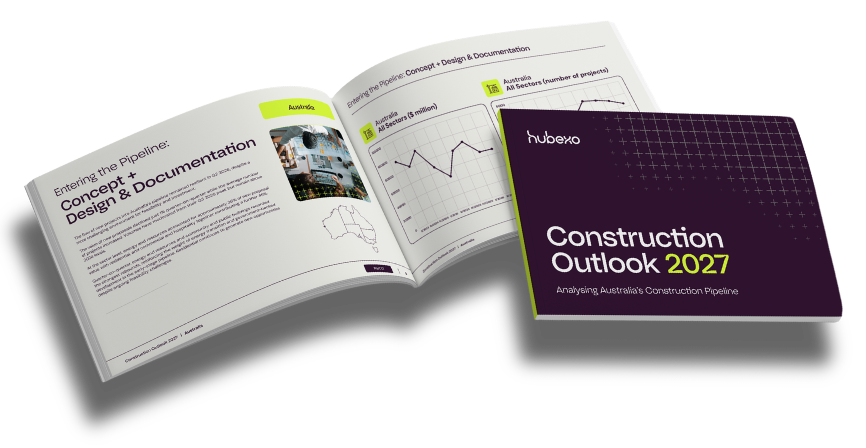
Australia, October 2026 — Australia’s construction industry heads into 2027 with a large pipeline, low blockage rates and a forecast surge in commencements. But the bar for turning projects into construction is higher than ever.
Findings from Hubexo’s Construction Outlook for 2027 draw on three sources:
– National project data from its project intelligence platform LeadManager
– A nationwide Sentiment Survey
– In-depth interviews with leaders across development, architecture and construction
The annual report tracks activity across every major sector and state, with data current to Q2 2026 and commencement forecasts to Q2 2027. It covers residential, commercial and hospitality, community and public buildings, industrial, infrastructure and transport, and energy and resources.
The Pipeline
New project proposals held up despite tougher feasibility conditions. Proposal value dipped just 1% quarter-on-quarter in Q2 2026, while project numbers kept rising. Energy and resources made up around 36% of new proposal value, and residential plus commercial and hospitality added a further 45%. Major projects entering the pipeline include:
– The approx. $10 billion Muswellbrook Battery & Data Centre in NSW
– The $3.15 billion Bonney Downs Wind Farm in WA
Few projects are leaving the pipeline. National deferrals fell to 1.5% and abandonments held at 1.3%. The pressure is uneven, though:
– Energy and resources recorded a 6.3% deferral rate, reflecting the scale and complexity of its projects.
– Residential had the highest abandonment rate nationally at 2.7%, rising to 5.0% in Victoria.
Both the value and number of commencements are forecast to rise substantially between Q3 2026 and Q2 2027:
– Energy and resources is expected to account for 36.8% of commencement value.
– Industrial, infrastructure and transport is expected to account for 25.6%.
– Residential is expected to account for 20.1%.
NSW/ACT, VIC, QLD and WA are forecast to make up around 87% of total commencement value.
Market Sentiment & Insights
Expectations for 2027 are steady rather than bullish:
– 42% of respondents expect more work and 46% expect about the same. Only 12% expect a decline.
– Growth and expansion is now the top business priority for every group, rising to 62% for builders.
– Low margins as a project challenge for builders fell 15 points year on year.
Delays and labour are where the strain shows:
– Delays remain the leading project challenge. 78% of builders report them (up 10 points), as do 70% of developers (up 15 points).
– Acquiring talent is still the top people challenge for every group. For builders, holding onto talent jumped 19 points to 60%, so a hiring problem has become a retention problem.
– Market insecurity, inflation and rising supply and services costs continue to weigh on feasibility.
On technology, cost is no longer the main barrier to adoption. Changing established practices and behaviours now ranks first for developers, architects and builders. AI is the most sought-after technology across the industry, but expectations are measured: 40% of respondents don’t expect it to affect productivity in the next five years. Value is showing up where firms change their processes around the tool.
Hubexo Commentary
“Australia doesn’t have a pipeline problem. It has a conversion problem. New proposals are holding up, deferrals and abandonments are low, and commencements are forecast to climb sharply into 2027. But the threshold for getting a project to site is higher than it’s been in years. Projects with strong demand, secure capital and a realistic delivery plan will move. Those that can’t make the numbers work will need to be repriced, redesigned or put on hold.”
— Ashleigh Porter, President, APAC, Hubexo
“Energy, data centres, transport and housing are competing for the same finite pool of skilled people and delivery capacity. For builders, the challenge is not simply winning work—it’s choosing where to deploy their people and where they can deliver the strongest returns. In 2027, success will come down to backing the right projects, protecting margins and finding smarter ways to deliver.”
— Ashleigh Porter, President, APAC, Hubexo
For media inquiries:
ABOUT HUBEXO
Hubexo, formerly Byggfakta Group, was founded in Sweden in 1936. At the core of Hubexo’s offerings are five key product pillars—Market Intelligence, Project Information, Product Information, Specification and eTendering—that together create a powerful ecosystem spanning 1.3 million active projects, 50,000 customers and 25 countries. Hubexo’s global product network drives better decision-making, unlocks sales opportunities and promotes sustainable construction. Hubexo provides clients with the insights needed to navigate the complex construction landscape, boosting growth and driving efficiency through advanced technology solutions.